
To understand the National Quality Standard (NQS), we need to understand its context within the National Quality Framework (NQF).
The NQF was introduced in 2012 to raise quality and drive continuous improvement in the Early Childhood Education and Care (ECEC) sector. It comprises of:
- Education and Care Services National Law & National Regulations
- The National Quality Standard (NQS)
- A national quality rating & assessment process
- Approved Learning Frameworks: EYLF & MTOP
Central to the administration of the NQF is the roles of the state/territory regulatory authorities and the Australia Childcare Education and Care Quality Authority (ACECQA).
Prior to this arrangement, licensing and quality assurance processes were left to individual states and territories. But since 2012, a national approach to quality education and care is delivered under the NQF.
As well as being underpinned by National Law and National Regulations, The NQF is shaped by its guiding principles, which are:
- The right and best interests of the child are paramount.
- Children are successful, competent and capable learners.
- Equity, inclusion and diversity underpin the framework.
- Australia’s Aboriginal and Torres Strait Islander cultures are valued.
- The role of parents and families is respected and supported.
- Best practice is expected in the provision of education and care services.

What are the 7 Quality Areas of The National Quality Standard?
NQS stands for ‘National Quality Standard’ (not standards, like some believe). It sets the benchmark – or standard – for the quality of education and care services in Australia.
Informed by research on best practice and how high-quality education and care contributes to positive outcomes for children, The NQS comprises of 7 quality areas:
- QA1: Educational program and practice
- QA2: Children’s health and safety
- QA3: Physical environment
- QA4: Staffing arrangements
- QA5: Relationships with children
- QA6: Collaborative partnerships with families and communities
- QA7: Governance and Leadership
Each quality area focuses on an area of practice that is important to outcomes for children. They comprise of several quality standards (high-level outcome statements), which are then made up of quality elements (descriptions of the outcomes that contribute to the standard).
Let’s go through the 7 quality areas, 18 standards, and 58 elements that make up the National Quality Standard.

NQS Quality Area 1: Educational Program and Practice
“Educational program and practice of educators are child-centred, stimulating and maximise opportunities for enhancing and extending each child’s learning and development.”
Quality Area 1 aims to ensure that the educational program and practice is stimulating and engaging, and enhances children’s learning and development.
It starts with using approved learning frameworks, such as the EYLF.
| Standard 1.1 | Program | The educational program enhances each child’s learning and development. |
| Element 1.1.1 | Approved learning framework | Curriculum decision-making contributes to each child’s learning and development outcomes in relation to their identity, connection with community, wellbeing, confidence as learners and effectiveness as communicators. |
| Element 1.1.2 | Child-centred | Each child’s current knowledge, strengths, ideas, culture, abilities and interests are the foundation of the program. |
| Element 1.1.3 | Program learning opportunities | All aspects of the program, including routines, are organised in ways that maximise opportunities for each child’s learning. |
| Standard 1.2 | Practice | Educators facilitate and extend each child’s learning and development. |
| Element 1.2.1 | Intentional teaching | Educators are deliberate, purposeful, and thoughtful in their decisions and actions. |
| Element 1.2.2 | Responsive teaching and scaffolding | Educators respond to children’s ideas and play and extend children’s learning through open-ended questions, interactions and feedback. |
| Element 1.2.3 | Child directed learning | Each child’s agency is promoted, enabling them to make choices and decisions that influence events and their world. |
| Standard 1.3 | Assessment and planning | Educators and co-ordinators take a planned and reflective approach to implementing the program for each child. |
| Element 1.3.1 | Assessment and planning cycle | Each child’s learning and development is assessed or evaluated as part of an ongoing cycle of observation, analysing learning, documentation, planning, implementation and reflection. |
| Element 1.3.2 | Critical reflection | Critical reflection on children’s learning and development, both as individuals and in groups, drives program planning and implementation. |
| Element 1.3.3 | Information for families | Families are informed about the program and their child’s progress. |

NQS Quality Area 2 – Children’s Health and Safety
“Children have the right to experience quality education and care in an environment that safeguards and promotes their health, safety and wellbeing.”
Quality Area 2 is all about safeguarding and promoting children’s health and safety, minimising risk, and protecting children from harm. QA2 is underpinned by the right children have to experience quality education and care that supports each child’s wellbeing, competence, confidence and independence.
| Standard 2.1 | Health | Each child’s health and physical activity is supported and promoted. |
| Element 2.1.1 | Wellbeing and comfort | Each child’s wellbeing and comfort is provided for, including appropriate opportunities to meet each child’s need for sleep, rest and relaxation. |
| Element 2.1.2 | Health practices and procedures | Effective illness and injury management and hygiene practices are promoted and implemented. |
| Element 2.1.3 | Healthy lifestyle | Healthy eating and physical activity are promoted and appropriate for each child. |
| Standard 2.2 | Safety | Each child is protected. |
| Element 2.2.1 | Supervision | At all times, reasonable precautions and adequate supervision ensure children are protected from harm and hazard |
| Element 2.2.2 | Incident and emergency management | Plans to effectively manage incidents and emergencies are developed in consultation with relevant authorities, practised and implemented |
| Element 2.2.3 | Child protection | Management, educators and staff are aware of their roles and responsibilities to identify and respond to every child at risk of abuse or neglect. |
NQS Quality Area 3: Physical Environment
“Physical environment is safe, suitable and provides a rich and diverse range of experiences that promote children’s learning and development.”
Quality Area 3 places importance on a physical environment that is safe, suitable, and provides a rich and diverse range of experiences that promote children’s learning and development.
As the physical environment is designed, equipped and organised, it shapes the way the space and resources are used. By placing importance on physical environment, education and care services can maximise children’s engagement, level of positive experience and inclusive relationships.
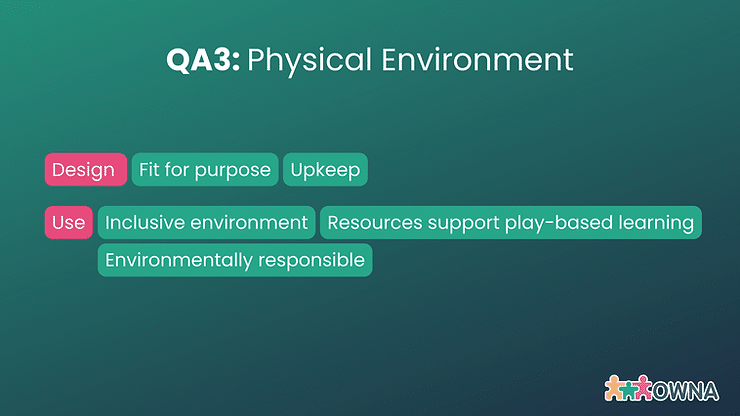
| Standard 3.1 | Design | The design of the facilities is appropriate for the operation of a service. |
| Element 3.1.1 | Fit for purpose | Outdoor and indoor spaces, buildings, fixtures and fittings are suitable for their purpose, including supporting the access of every child. |
| Element 3.1.2 | Upkeep | Premises, furniture and equipment are safe, clean and well maintained. |
| Standard 3.2 | Use | The service environment is inclusive, promotes competence and supports exploration and play-based learning. |
| Element 3.2.1 | Inclusive environment | Outdoor and indoor spaces are organised and adapted to support every child’s participation and to engage every child in quality experiences in both built and natural environments. |
| Element 3.2.2 | Resources support play-based learning | Resources, materials and equipment allow for multiple uses, are sufficient in number, and enable every child to engage in play-based learning. |
| Element 3.2.3 | Environmentally responsible | The service cares for the environment and supports children to become environmentally responsible. |

NQS Quality Area 4: Staffing Arrangements
“Qualified and experienced educators, who develop warm, respectful relationships with children, create predictable environments and encourage children’s active engagement in the learning program.”
Quality Area 4 ensures that qualified and experienced educators, coordinators and nominated supervisors are able to develop warm, respectful relationships with children, create safe and predictable environments, and encourage children’s active engagement in the learning program.
| Standard 4.1 | Staffing arrangements | Staffing arrangements enhance children’s learning and development. |
| Element 4.1.1 | Organisation of educators | The organisation of educators across the service supports children’s learning and development. |
| Element 4.1.2 | Continuity of staff | Every effort is made for children to experience continuity of educators at the service. |
| Standard 4.2 | Professionalism | Management, educators and staff are collaborative, respectful and ethical. |
| Element 4.2.1 | Professional collaboration | Management, educators and staff work with mutual respect and collaboratively, and challenge and learn from each other, recognising each other’s strengths and skills. |
| Element 4.2.2 | Professional standards | Professional standards guide practice, interactions and relationships. |

NQS Quality Area 5 – Relationships with Children
“Relationships with children are responsive, respectful and promote children’s sense of security and belonging.”
Quality Area 5 is all about promoting responsive, respectful relationships with children that free them to explore the environment and engage in play and learning. It also aims to promote children’s sense of security and belonging.
| Standard 5.1 | Relationships between educators and children | Respectful and equitable relationships are maintained with each child. |
| Element 5.1.1 | Positive educator to child interactions | Responsive and meaningful interactions build trusting relationships which engage and support each child to feel secure, confident and included. |
| Element 5.1.2 | Dignity and rights of the child | The dignity and rights of every child are maintained. |
| Standard 5.2 | Relationships between children | Each child is supported to build and maintain sensitive and responsive relationships. |
| Element 5.2.1 | Collaborative learning | Children are supported to collaborate, learn from and help each other. |
| Element 5.2.2 | Self-regulation | Each child is supported to regulate their own behaviour, respond appropriately to the behaviour of others and communicate effectively to resolve conflicts. |

NQS Quality Area 6: Collaborative Partnerships with Families and Communities
“Collaborative relationships with families are fundamental to achieving quality outcomes for children, and community partnerships based on active communication, consultation and collaboration are essential.”
Quality Area 6 recognised that collaborative relationships are fundamental to achieving positive outcomes for children, and community partnerships that are based on communication, consultation and collaboration are essential.
| Standard 6.1 | Supportive relationships with families | Respectful relationships with families are developed and maintained and families are supported in their parenting role. |
| Element 6.1.1 | Engagement with the service | Families are supported from enrolment to be involved in the service and contribute to service decisions. |
| Element 6.1.2 | Parent views are respected | The expertise, culture, values and beliefs of families are respected and families share in decision-making about their child’s learning and wellbeing. |
| Element 6.1.3 | Families are supported | Current information is available to families about the service and relevant community services and resources to support parenting and family wellbeing. |
| Standard 6.2 | Collaborative partnerships | Collaborative partnerships enhance children’s inclusion, learning and wellbeing. |
| Element 6.2.1 | Transitions | Continuity of learning and transitions for each child are supported by sharing information and clarifying responsibilities. |
| Element 6.2.2 | Access and participation | Effective partnerships support children’s access, inclusion and participation in the program. |
| Element 6.2.3 | Community Engagement | The service builds relationships and engages with its community. |

NQS Quality Area 7: Governance and Leadership
“Effective leadership and governance of the service contributes to quality environments for children’s learning and development. Effective leaders establish shared values for the service and set clear direction for the service’s continuous improvement.”
Quality Area 7 aims to support effective leadership and management of a childcare service in a way that contributes to quality environments for children’s learning and development, creating a learning community that strives for continuous improvement.
Examples of this include:
- Well-documented policies & procedures
- Well-maintained records
- Shared values
- Clear direction
- Reflective practices
| Standard 7.1 | Governance | Governance supports the operation of a quality service. |
| Element 7.1.1 | Service philosophy and purpose | A statement of philosophy guides all aspects of the service’s operations. |
| Element 7.1.2 | Management systems | Systems are in place to manage risk and enable the effective management and operation of a quality service. |
| Element 7.1.3 | Roles and responsibilities | Roles and responsibilities are clearly defined, and understood, and support effective decision making and operation of the service. |
| Standard 7.2 | Leadership | Effective leadership builds and promotes a positive organisational culture and professional learning community. |
| Element 7.2.1 | Continuous improvement | There is an effective self-assessment and quality improvement process in place. |
| Element 7.2.2 | Educational leadership | The educational leader is supported and leads the development and implementation of the educational program and assessment and planning cycle. |
| Element 7.2.3 | Development of professionals | Educators, co-ordinators and staff members’ performance is regularly evaluated and individual plans are in place to support learning and development. |
Download Your FREE National Quality Standard Poster
Want a handy guide for whenever you need to refer to the NQS quality areas, standards or elements?